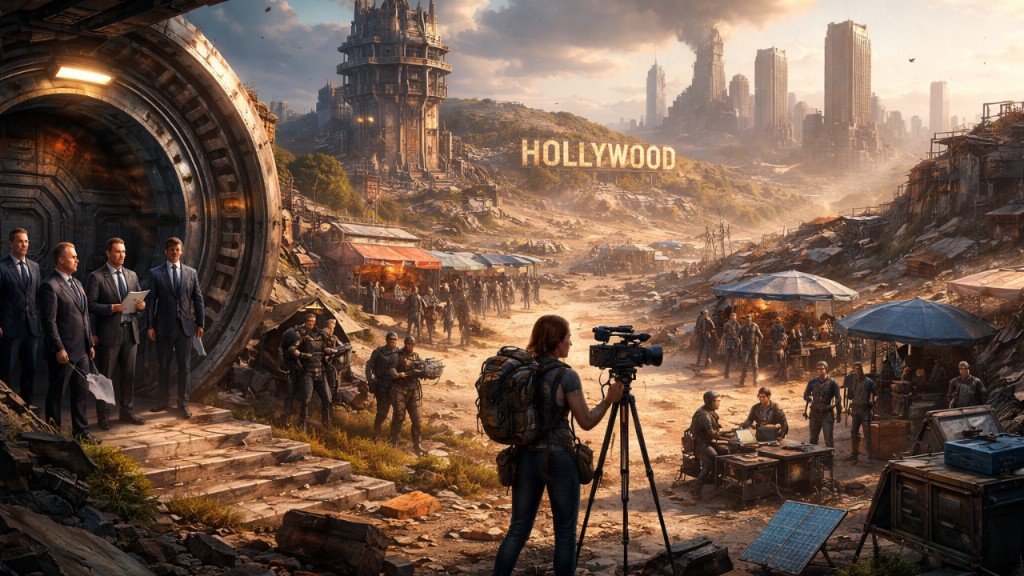
In quick conversations with colleagues, I've found it easier to describe the media and entertainment industry as "in complete collapse". Every function within every area is changing in some way, but not necessarily evolving. There just isn't enough time to say it's a thickening quagmire of oppressive complexity driven by corporate outcomes and consensus decision-making. A version of this conversation feels familiar to whomever has been tasked with implementing technology anywhere into the content supply chain, from camera to consumer. The solution went live on a Tuesday, and by Friday, the tracking spreadsheet had returned. It came back because when the pressure mounted, humans reverted to the ritual they know, the one that feels right to get the job done. From the outside, it looks like the technology failed, but it was actually a "flail-ure"; a launch that neither succeeds nor fails; just flails. The tool had the technical capability it was designed for, but the work just didn't flow, and there wasn't time to ask why. Falling back to the ritual happens often, especially when a new system is deployed, no matter how revolutionary.
I decided to write on the subject, and in particular, how the entertainment industry is impacted by technology. Since I'm not a writer, I'll borrow inspiration from entertainment to help keep it interesting. I was inspired to write this article after watching Fallout and professionally relating to every character in some way. The show portrays the same world from different points of view in a way that I hadn't previously correlated to my professional life. There are wide-eyed optimists forging zealously towards an idealistic future paired with grizzled veterans wondering how and why they're still alive. On that spectrum are competing industrial complexes whose influence outlives the company's ability to profit from it, and tribal pockets of industrious scavengers trading in bottle caps. If just one person affirms the metaphor, I'll be happy. This isn't to call our industry irredeemable, it's to lay bare the reality around us, and reach towards a future version of our industry that's fun again.
Operating in the studio system of creative production and distribution can feel like you're navigating a wasteland, constantly pressing ahead, veering off into side quests, but barely remembering why, or for whom. You're guided through obscurity only by decaying landmarks as you hopscotch between pockets of scarce resources. The landmarks provide comfort and concern at the same time. You're reassured by their familiarity, but are made uneasy by how different they now appear. The landscape feels abandoned, but you occasionally stumble upon pockets of productive life. You must be heroic to survive, but the heroes can't get exhausted by the fight. If we're in a dystopia, I believe the future is more likely to be a neo-dystopia than a utopia. We will work differently and surely figure out a new way of delivering on old promises. If we find the energy to push through, we'll get the opportunity to work really hard at delivering on worthy goals. The worthy goal is art after all. If art is the romantic concept of a universal emotional language that connects humans; it's definitely still thriving, and more important than ever.
In my experience, a successful operation is categorized by the efficient coordination of three key components: people, process, and systems. Any deficiency within and between these components creates friction of some kind. Not all friction is fatal, but almost all friction is expensive. It's important to separate the idea of cost from profitability. There are profitable operations that are not efficient, and there are efficient operations that are not profitable. Creative production isn't taught in business school, and I'm not personally interested in an academic exploration of the subject. The categories I've outlined are an aide to help illustrate my point by attempting to bridge language between "art" and "systems theory". I believe that creating art should be fun, even when enterprise is involved. Now that I'm jumping into the chaotic surface life as an independent concern, I intend to improve our industry with learned experiences that I've survived. I haven't always had the terminology, but I've come to realize that I've always been at the central cortex of people, process, and systems. While the systems we use to deliver those human connections are constantly evolving, so are the people and processes that run them. Strangely, each of these components appears to be evolving independently at different rates. At my most hopeful, I endeavor to help them all land in some cohesive future state.
Technology doesn't resolve complexity; it reveals it. Workflow is the bridge in the valley between motion and progress.
For context, I started in film processing, developing theatrical film prints, and ultimately original camera negatives (16mm, 35mm, 65/70mm) for popular series and features (and yes there were plenty of vaults). In the early 2000s, after six years on graveyard shift, I transitioned into varied forms of digital distribution where I delivered studio content to every consumer platform (theatrical, broadcast, streaming, DVD/Blu-ray, set-top box, etc.). In that time, I learned about building solutions and software around scaled content operations. I ultimately followed the technological innovation upstream to the studio's creative production systems, where I led teams that delivered enterprise-scale cloud management operations that enabled millions in cost savings.
In a recent role, I was charged with deploying cloud content management for third-party production partners all over the world. The goal was simple: reduce storage costs and protect IP. The studio had partnered with an enterprise cloud provider in exchange for discounted pricing, so the incentives were aligned. The provider wanted a reference customer, the studio wanted cost savings. Until that point, original camera content was mostly managed directly by the production's vendors on external hardware in disparate locations; it might as well have been invisible (or buried in a vault). On almost every production, this led to surprise storage-related costs, post-production delays, or worse. When I started the program, the urgency was real. The pandemic had already forced remote collaboration, and there was no end in sight. The storage offering was mature; over a decade old by 2020. It was already cost-efficient, much cheaper than the on-premise storage systems. Internally, the benefits of cloud storage were well known, widely marketed, and frequently cited.
Inside the vault, infrastructure is designed, on the surface, infrastructure is forged.
What made a transition hard for productions wasn't realizing the technical potential; but rather their ability to articulate the nuance of "workflow" to builders. The interdependency between people, processes, and systems wasn't well understood, and the deal-makers hadn't considered it important to understand it. When done well, workflow is a poetic square dance; otherwise, it's a muddy mosh pit; there doesn't seem to be any in-between. Solving a seemingly basic problem like "store content here instead of there" ultimately required a ground-up reengineering of multiple layers of technical, financial, and operational processes; not just inside our studio, but across many other companies. We had to earn trust through intensive collaboration, then deliver when it mattered most. We invented new production onboarding processes, communicated them, and handled any exceptions along the way, globally. Once a partner was "in production", the urgency demanded that we implement hyper-care protocols that assumed the change would flail and that not even 10 minutes of downtime would be tolerated. We used traditional help desk protocols and customized them for a high-context team that was on-call 24/7 to recover from any issues quickly. We implemented the most stringent service level agreements (SLAs) and incentivized personnel to meet or beat them. For our transformation to be effective, the production workflow had to become more than lines and squares, it had to become a "persona" that lived and breathed (even if only through the words of others), and that we were in service of. Only then could we build new rituals, the purpose-built processes that productions accepted, that created the spaces where we could collaborate. But before we deployed any new processes, we first had to reengineer our thinking.
Instead of seeing production personnel as contextually equal partners, we consciously decided to treat them as customers of a technology service. This recalibration made all the difference. What we lacked in production workflow context, the productions lacked in modern technology support. To be fair, most of our customers had only experienced "IT" in the corporate sense, and most of that experience hadn't been positive.
To simplify, I'll categorize the creative supply chain (script to screen) into five broad categories: Pre-Production, Production, Post-Production, Localization, and Distribution. These categories aren't necessarily departments, although departments may have these names. Instead, they represent clusters of activity where individuals within each category tend to quickly recognize and collaborate with each other, even across different studios. The first three categories each have distinct contractual milestones that occur before, during, and after the production phase. These milestones create a shorthand that is recognized and ported across various production types (features, episodic, animations, reality, etc.). Consumer-facing player requirements push localization and distribution terminology closer to standardization and familiarity within each area.
If workflow were only the coordinated squaredance of people, processes, and systems delivering to consumers, not much has changed. When we zoom in, each activity has at least been conceptually disrupted, if not actually disrupted. In this series, I plan to cover examples in every category at some point. Draw your workflow in pencil, because you might as well view every diagram through a kaleidoscope lens. It's nearly impossible to document a clear picture of a workflow, and even harder for it to remain the same long enough to build a system around it. Observing from the outside isn't comprehensive, and from the inside, it's always changing. It seems different for everyone, depending on where they are in the supply chain and when they're looking at it (or where they learned it). Documenting it makes it feel robust, but it's incredibly fragile in flight. Unlike manufacturing, repetition doesn't seem to stabilize creative workflows; they only seem to move on their own inertia. When the kinetic energy shifts, a nearby superhuman is usually able to keep it spinning. There is rarely time to ask why a workflow broke, and when time does allow it, facts are ephemeral, and conditional realities are often lost. Simply put, media workflows require a deeper understanding in breadth and depth than time allows, and that's tough for technology.
In our effort to migrate productions to use cloud storage during production rather than after it, our studio technology team was missing a lot of context. What worked for one show didn't work for other shows, even "smaller" less intensive ones. To make progress on the cloud migration goals, we assembled and embedded a technical operations team that owned "first responder" technical activities like identity and incident management. This allowed us to observe creative workflows as they progressed through the system. From cameras to hard drives, through the network to local storage, and ultimately to the cloud. From the cloud, we observed the logistical acrobatics used to get content to and from the multiple VFX vendors across the globe, all without losing the critical canonical metadata of the original frames. This is obvious now, but the overall size of the "payloads" didn't matter all that much, even though the storage pricing was based on it. What we learned was that the sheer quantity of original frames, proxies, outbound metadata and return metadata, and all the compute-intensive checks in between weren't compute or storage problems; they were logistics problems. In this context, the logistics of trafficking original camera content is not anything like digital asset management (DAM). It's not to say that logistics are completely ironed out with on-premise storage, either. What we came to learn was that part of the intrinsic value of creative service vendors wasn't just the actual creative service (dailies, color correction, offline, online, transcode, QC), it was the techno-industrial complex they'd built. A key "soft offering" of the vendors was the expert context needed to recover from the inevitable workflow exceptions, even between competitor companies. The dailies vendor was the "storage center" and had known pathways between VFX, edit and finish vendors. On those pathways, pipelines were built that included automation and orchestration which performed tasks like checksums, proxy creation and quality control. Automated recovery, robust reporting, and well-documented intervention methods were all "built-in". Those pipelines were generally bespoke to the source vendor and often tailored to vendor/work type combinations. Almost every system we encountered was locally rational and globally incoherent. They were optimized to survive inside its own boundary while ignoring context everywhere else. The newer platforms didn't fail to deliver value because they were incapable; they failed because they tried to replace a technology without respecting the workflow. We made progress on our transformation mission only when we respected that value and architected to interoperate with it, rather than around it. This meant that the humans weren't forced to contort themselves around a system, which in turn built the trust necessary for even more inevitable change. We delivered transformation by building in operational flexibility that considered how work actually moves. What we delivered was cheaper, more resilient and adaptable. The directive to support interoperability allowed our customers to benefit from all sorts of modern technology which was our version of the "virtuous cycle".
When working at the intersection of technology and entertainment, there is no shortage of topics, opinions, truisms, theories, facts, and misinformation. I'm not a writer, but I have a lived work experience that is unique and a career trajectory that certainly wasn't standard. The Fallout narrative structure gave me the inspiration to share my experience, mostly as catharsis, but also to establish a ground-truth from which to build. My hope with this series is to reinforce the optimistic tone of ovaion solution studio and earnestly provide service to others. Please let me know if you have particular topics of interest and I'll do my best to share, either directly or in partnership with others.
Along the way, I may just figure out if I'm Lucy Maclean, Cooper Howard (pre-apocalypse), the ghoul, Maximus, or just a bottle-cap trader.
Bastien M. · www.ovaion.com · LinkedIn